

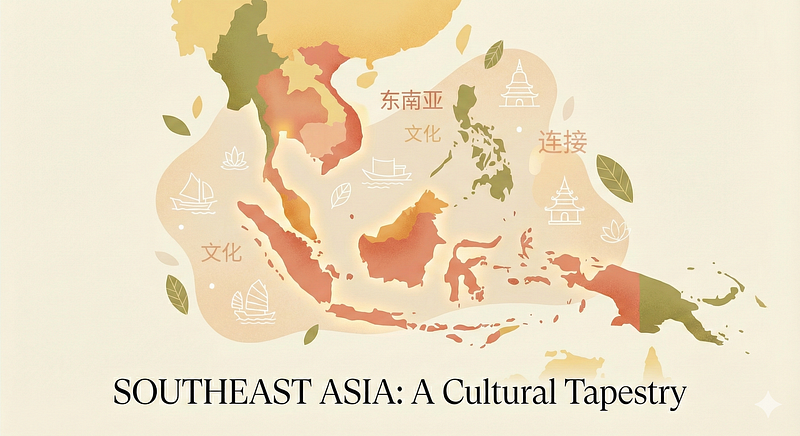
For years, conversations about Mandarin education have centred on China, international schools, or diaspora communities. But the most dramatic shift in Mandarin learning is unfolding somewhere unexpected: Southeast Asia.
Across Vietnam, Indonesia, Malaysia, Singapore, and Thailand, Mandarin is no longer treated as a “supplementary language.” It is increasingly seen as economic literacy — a skill intertwined with mobility, opportunity, and participation in a rapidly shifting regional economy.
This transformation didn’t happen overnight. It emerged at the intersection of policy, demographics, technology, and parental aspirations. And it is reshaping what the next generation of bilingual education could look like.
1. The Economic Gravity Pulling ASEAN Toward Mandarin
ASEAN is now China’s largest trading partner, and Chinese investment — both private and state-linked — touches nearly every major infrastructure and manufacturing corridor in the region. For families in Southeast Asia, Mandarin proficiency is no longer an abstract cultural asset; it is a career differentiator.
In countries like Vietnam, where a large share of foreign manufacturing is shifting, economic integration with China is accelerating. In Indonesia, Chinese participation in electric vehicles, infrastructure, and mining has created demand for bilingual professionals. Parents are reading the signals clearly: Mandarin is becoming a requirement for navigating the region’s future economy.
2. Policy Momentum Is Outpacing Public Awareness
Perhaps the most underreported trend is the gradual inclusion of Mandarin in national education strategies.
Vietnam’s decision to introduce Mandarin into its public school curriculum marks a significant milestone. Malaysia continues expanding its national-stream Mandarin offerings. Thailand and Indonesia are piloting bilingual and trilingual models that incorporate Chinese language exposure.
These policy movements may appear incremental, but their long-term implications are vast: when public school systems shift, entire generations shift with them.
3. A New Generation of Parents Thinks Differently About Learning
Today’s Southeast Asian parents are not simply looking for rote memorization or textbook proficiency. They are:
- data-literate,
- outcome-driven,
- technology-comfortable, and
- deeply pragmatic about education.
For them, Mandarin isn’t about cultural signalling; it’s about preparedness. They want their children to be able to speak, read, and apply the language in real contexts — not just pass exams.
This mindset creates demand for learning experiences that are structured, measurable, and engaging, not just traditional classroom instruction.
4. The Structural Bottleneck: Not Enough Teachers
The biggest obstacle to scaling Mandarin education in ASEAN is not interest — it is capacity.
Qualified Mandarin teachers, especially those trained in early childhood pedagogy, are in short supply across the region. Even where demand is strong, supply constraints limit the ability of schools to expand programs.
This shortage shapes everything:
- class sizes increase,
- instruction time becomes limited,
- and quality varies dramatically between schools.
This is one of the reasons Southeast Asia is prime ground for alternative delivery models, hybrid learning, and supplemental systems that reduce reliance on scarce human resources.
5. Technology Is Reshaping What “Practice” Means
While technology should never be framed as the sole solution, it is clear that digital tools are enabling forms of learning that were previously impossible at scale.
For example:
- Pronunciation feedback — especially for tonal accuracy — can now be delivered instantly and privately, without requiring one-on-one teacher time.
- Micro-learning loops allow students to reinforce skills daily, not only during weekly classes.
- Adaptive content generation ensures students receive appropriate reading and vocabulary challenges aligned to their level.
- Multi-sensory tools (digital or physical) bridge the gap between recognition, comprehension, and application.
These technologies do not replace teachers. They amplify what teachers can do by shifting routine tasks — like repetition and correction — to environments where every child can practice freely and frequently.
In regions with teacher scarcity, this matters profoundly.
6. Why Southeast Asia Might Leapfrog Other Regions
Southeast Asia has a pattern of leapfrogging traditional systems. Mobile banking leapfrogged physical branches. E-commerce leapfrogged retail infrastructure. Digital payments leapfrogged credit card penetration.
Mandarin learning may be next.
Because the unmet demand is so large — and the structural teacher bottleneck so persistent — ASEAN could adopt hybrid and technology-assisted learning models much faster than Western markets, where traditional systems are more entrenched.
When necessity and innovation meet, adoption accelerates.
7. A Region That Will Shape the Future of Bilingual Education
What’s emerging in Southeast Asia is not just increased demand for Mandarin learning. It is an entirely new paradigm for bilingual education, shaped by:
- public policy shifts,
- competitive labour markets,
- multicultural environments,
- parental pragmatism,
- and a blend of traditional and technology-enabled pedagogy.
In this sense, ASEAN is not following China’s lead — it is charting its own path.
A Personal Note
Having spent the past few years working closely with educators, parents, researchers, and learning centres across the region, I’ve seen this transformation unfold firsthand. The speed at which Southeast Asia is redefining Mandarin education is faster than most observers realize.
This is not simply a story about language. It is a story about aspiration, opportunity, and how a region prepares its children for a rapidly shifting future.
Mandarin just happens to be the lens — but the underlying story is much bigger.